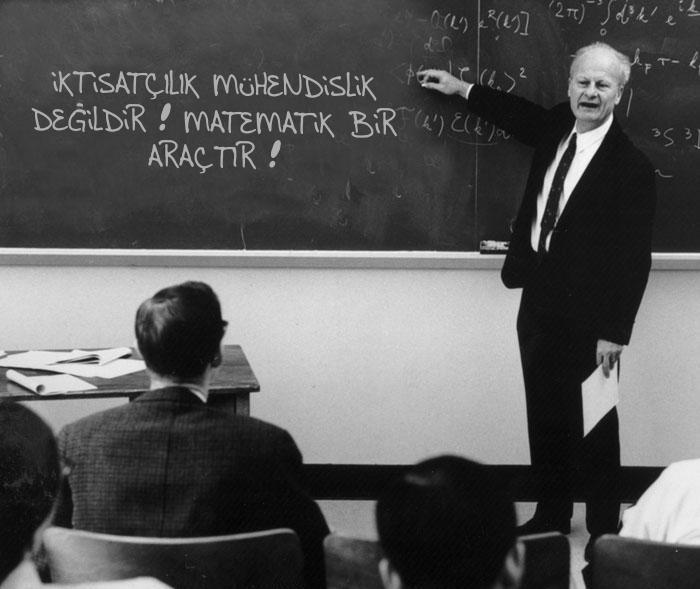
Birmingham Üniversitesi öğretim üyelerinden iktisat tarihi ve felsefesi profesörü Roger Backhouse'a göre, "The mathematization of economics is probably the most important development in the history of twentieth-century economics." İktisattaki "matematikselleşmenin aşırı olduğu" (over-mathematization) ve bunun yarattığı tehlikleler ise uzun yıllardır dile getiriliyor. Ancak yine de, gerek ABD gibi iktisat alanındaki öncü ülkelerin gerekse ülkemizdeki seçkin dört-beş üniversitenin iktisat bölümlerinde, en doğru (hatta tek?) iktisatçılığın "matematiksel iktisatçılık" olduğu yönünde güçlü eğilimler var. Matematikselleşme meselesi hakkında, Blaug'un iddiası (Szenberg ve Ramrattan, 2004: 90) ve Scherer'in bulguları (Szenberg ve Ramrattan, 2004: 396-7) göstermektedir ki, iktisat geleneksel olarak bilimlerin en katısı/serti olarak bilinen fizikten bile çok daha matematiksel (ve daha az ampirik) bir hale gelmiştir.
W. Stanley Jevons: "all economic writers must be mathematical so far as they are scientific at all ..."
Wassily Leontief (1971: 2) once pointed out: "The mathematical model-building industry has grown into one of the most prestigious, possibly the most prestigious branch of economics."
Debreu; 1991'de, iktisadın aşırı matematikselleşmesinin yarattığı tehlikeyi şöyle dile getirmiştir:
"In the past two decades, economic theory has been carried away further by a seemingly irresistible current that can be explained only partly by the intellectual successes of its mathematization. Essential to an attempt at a fuller explanation are the values imprinted on an economist by his study of mathematics. When a theorist who has been so typed judges his scholarly work, those values do not play a silent role; they may play a decisive role. The very choice of the questions to which he tries to find answers is influenced by his
mathematical background. Thus, the danger is ever present that the part of economics will become secondary, if not marginal, in that judgment. (Debreu, 1991: 5)
William J. Baumol is among the increasing number of economists today who are discomfited by the increasing trend in economics toward over-mathematization and the focus on technique over substance. Baumol's left-leaning economic ideology is, to a large extent, due to his Marxist upbringing. According to Baumol, the success of economics "is to be measured primarily to the extent to which it can help to reduce unemployment and poverty and to improve the quality of life. However, in arguing this I should not be taken to be questioning the value of "pure" economic research....The only caveat I would address to those who are engaged in very abstract research is to urge the utmost caution before hastening to apply its results to the complex issues of reality." (Kaynak)
Beed ve Kane (1991) ise, aşırı matematikselleşme ile ilgili itirazları yedi noktada topluyorlar.
Colander, Holt ve Rosser (2004) "argue that economics is currently undergoing a fundamental shift in its method, away from neoclassical economics and into something new. Although that something new has not been fully developed, it is beginning to take form and is centered on dynamics, recursive methods and complexity theory. The foundation of this change is coming from economists who are doing cutting edge work and influencing mainstream economics. These economists are defining and laying the theoretical groundwork for the fundamental shift that is occurring in the economics profession."
Woo (1986): "The extensive mathematisation of economics has produced a "fossilisation" of economic concepts."
Daniel Little: "The formal or mathematical machinery of economics is intellectually valuable only insofar as it contributes to a better understanding of real, empirically given economic processes, causes, and systems."
Kaynakça:- Baumol, W. J. (1966): "Economic Models and Mathematics,? in S. R. Krupp (ed.), The Structure of Economic Science, Englewood Cliffs: Prentice-Hall, 88-101.
- Baumol, W. J. ve S. M. Goldfeld (eds.) (1968): Precursors in Mathematical Economics: An Anthology. London: London School of
Economics Series of Reprints of Scarce Works on Political Economy, No. 19. - Baumol, W. J. (1969): "Mathematics in Economic Analysis," in T. L. Saaty and F. J. Weyl, The Spirit and the Uses of the Mathematical Sciences, New York, NY: McGraw-Hill, 246-262.
- Beed, C. ve O. Kane (1991): "What Is the Critique of the Mathematization of Economics?" Kyklos, 44(4): 581-612.
- Colander, D., R. P. F. Holt, and B. J. Rosser, Jr. (2004): "The Changing Face of Mainstream Economics," Review of Political Economy, 16(4): 485 - 499.
- Debreu, G. (1991): "The Mathematization of Economic Theory," American Economic Review, 81(1): 1-7.
- Dow, S. C. (1999): "The Use of Mathematics in Economics," ESRC Public Understanding of Mathematics Seminar, Birmingham, 21-2 May.
- Dow, S. C. (2003): "The Relationship between Mathematics and Economics," Journal of Post Keynesian Economics, 25(4): 545-8.
- Grubel, H. G., L. A. Boland (1986): "On the Effective Use of Mathematics in Economics," Kyklos, 39(?): 419?442.
- Leijonhufvud, A. (1997): "Models and Theories," Journal of Economic Methodology, 4(2): 193-8.
- Leontief, W. (1954): "Mathematics in Economics," Bulletin of the American Mathematical Society, (May): 215- 233.
- Leontief, W. (1971): "Theoretical Assumptions and Nonobserved Facts," American Economic Review, 61 (March): 1-7.
- Mirowski, P. (1991): "The When, the How and the Why of Mathematical Expression in the History of Economic Analysis," Journal of Economic Perspectives, 5(Winter): 145?158.
- Little, D. (?): "Philosophy of Economics," Routledge Encyclopedia of the Philosophy of Science.
- Pogrebna, G. (2005): "Mathematical Formalism in Economics: Verdict of the Reality," Oeconomicus, Volume VII, 2004-2005, 83-109.
- Quddus, M. ve S. Rashid (1993): "The Overmathematization of Economics: Lessons for Business Disciplines," Journal for Education for Business, 68(5): 288-292.
- Quddus, M. ve S. Rashid (1994): "The Overuse of Mathematics in Economics: Nobel Resistance," Eastern Economic Journal, 20(3): 251-265. [arşiv] [yeni]
- Rashid, S. (1977): "William Whewell and Early Mathematical Economics", The Manchester School of Economic & Social Studies, 45(4): 381-91. [yeni]
- Rashid, S. (1994): "John von Neumann, Scientific Method and Empirical Economics", Journal of Economic Methodology, 1994, vol. 1, issue 2, pages 279-93. [yeni]
- Rashid, S. (2001): "Successful engineers and indifferent economists", Journal of Engineering Education, ... [arşiv] [yeni]
- Reed, L. W. (1977): "A Critique of Mathematical Economics," The Freeman (a publication of The Foundation for Economic Education, Inc.),27(4).
- Rosenberg, A. (1992): Economics - Mathematical Politics or Science of Diminishing Returns? Chicago: Chicago University Press.
- Rothschild, K. W. (1991): "The mathematization of economic theory: Gerard Debreu, American economic review 81 (1991) 1-7," European Journal of Political Economy, 7(4): 617.
- Schabas, M. L. (1989): "Alfred Marshall, W. Stanley Jevons, and the Mathematization of Economics," Isis, 80(No. 301, March): 60-73.
- Spiegel, H. W. (1997): "Refugee Economicsts and the Mathematization of Economics," in: H. Hagemann (ed.), Die deutschsprachige wirtschaftswissenschaftliche Emigration nach 1933, Marburg: Metropolis Verlag.
- Szenberg, M. ve L. Ramrattan (eds.) (2004): Reflections of Eminent Economists. Cheltenham, UK: Edward Elgar.
- Velupillai, K. V. (1996): "The Computable Alternative in the Formalization of Economics: A Counterfactual Essay," Kyklos, 49(3): 251-72.
- Velupillai, K. V. (2004): "The Unreasonable Ineffectiveness of Mathematics in Economics," Università degli Studi, Dipartimento di Economia, Discussion Paper No. 6.
- Weintraub, E. R. (1999): "How Should We Write the History of Twentieth-Century Economics?" Oxford Review of Economic Policy, 15(4): 139-52. [yeni]
- Weintraub, E. R. (2002): How Economics Became a Mathematical Science, Durham, NC: Duke University Press.
- Weintraub, E. R. (2005): Unpublished response to Salim Rashid?s ?Review of How Economics Became a Mathematical Science? that appeared in History of Political Economy. [yeni]
- Woo, H. (1986) What's Wrong with Formalization in Economics? Hong Kong: Victoria Press.
For other links and Search Results: "Mathematization in Economics" or "Mathematisation in Economics"
The Different Types Of Mathematics Seen In Quantitative FinanceDosya Biçimi: PDF/Adobe Acrobat - HTML olarak goruntulejustification for the mathematization of economics by one of its leading exponents.GRUBEL &. BOLAND ask whether the use of mathematics in economics has ...www.math.ntua.gr/greek/postgraduate/new_progr/ activities/ISMTF_2003/e-Proceedings/Alexakis.pdf
Potgieter and "Computability in Economics"